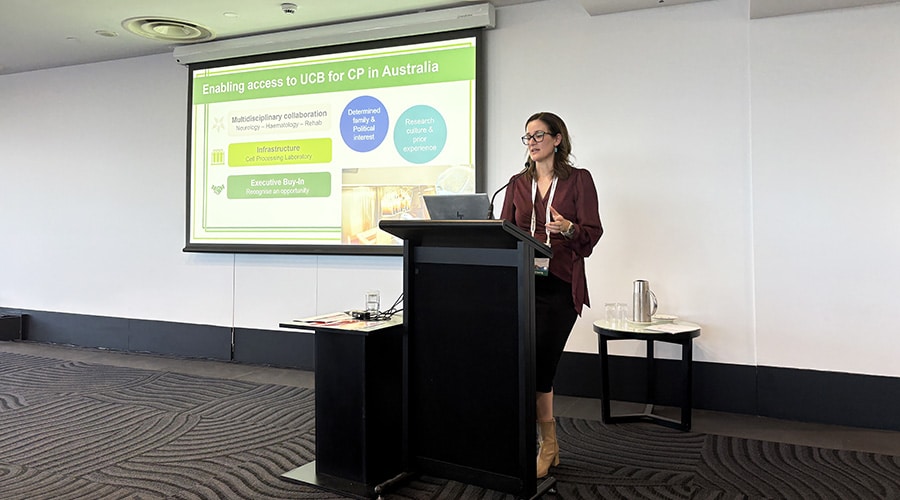
Published this week in the Journal of Paediatrics and Child Health, the study documents the first compassionate case in Australia of a child with cerebral palsy receiving their own umbilical cord blood through the Therapeutic Goods Administration’s Special Access Scheme.
Led by a team of researchers and clinicians from Cerebral Palsy Alliance Research Institute, Monash Health and Hudson Institute of Medical Research, the report shows there were no adverse effects and that the treatment was well tolerated. In the months following the April 2025 infusion at Monash Children’s Hospital, and alongside goal-directed therapy, the child showed meaningful improvements in movement, balance and fatigue. Her gross motor function scores improved well beyond what would normally be expected for a child with her level of cerebral palsy, and she experienced fewer falls during everyday activities at school.
This study confirms that cord blood treatment is not only possible under current regulations but that it can be done safely, using existing hospital systems and Australian protocols.
“This paper helps open the door to safer, fairer access to a therapy that may improve outcomes for some children with cerebral palsy,” said Dr Megan Finch-Edmondson, co-author and Program Lead, Regeneration at CPA.
The paper notes, that for cord blood treatment to become a new treatment avenue for CP and to address current inequities, there is a need to address barriers to access, including cost and regulation. Furthermore, national data collection, for example via a treatment registry, may support future decision-making.
Further information can be found in this article: https://thelimbic.com/neurology/australian-child-receives-own-cord-blood-to-treat-cerebral-palsy/
Learn more about cord blood treatment for cerebral palsy: https://cerebralpalsy.org.au/advocacy/umbilical-cord-blood/