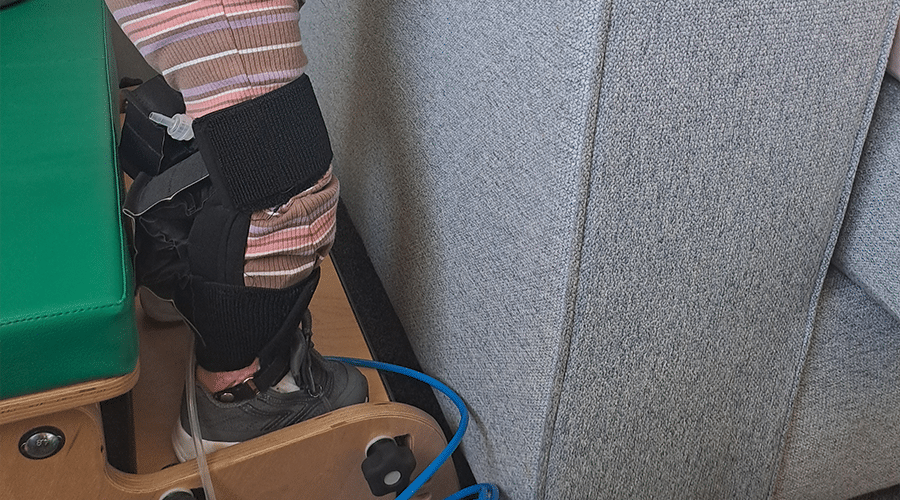
Researchers at the Cerebral Palsy Alliance (CPA) Research Institute, Dr Nicola Postol and Professor Alistair McEwan, have been awarded $98,170 from the Lionel and Yvonne Spencer Trust to further develop an innovative soft knee exoskeleton designed to support early mobility.
The project builds on CPA’s growing body of research into wearable mobility technology, following recent work highlighting both the promise of exoskeletons and the need for stronger clinical evidence before they become part of routine care.
Unlike many existing exoskeletons, which can be costly and designed for clinical settings, the team is developing a simple, lightweight and affordable device that families can use at home.
The soft knee exoskeleton is being designed to work alongside a walking frame, enabling children to practise walking more often while encouraging greater independence.
The goal is to increase the amount of walking practice children can do between therapy sessions, supporting one of the key principles of motor learning – more opportunities to practise meaningful movement.
“Children make progress through repetition and practice,” said Dr Nicola Postol.
“By developing a device that parents can use at home, we’re aiming to make intensive mobility practice more accessible while supporting children’s independence in everyday life.”
A key focus of the project is ensuring the technology is practical and accessible for the families who will use it.
The study will include co-design workshops in both metropolitan and regional NSW, helping the research team to identify the optimal design, before the device is tested by families in their homes.
This family-centred approach reflects CPA’s commitment to developing technologies that fit into everyday life, not just the clinic.
While the initial research will take place in NSW, the long-term vision reaches much further.
By creating a low-cost, easy-to-use mobility device, the researchers hope the technology could eventually improve access to rehabilitation in low- and middle-income countries, where access to specialised equipment is often limited.
Developing affordable assistive technologies has the potential to reduce barriers to early mobility support for children around the world.
The project also builds on CPA’s recent research exploring the use of exoskeletons for people with cerebral palsy.
A recent systematic review led by CPA researchers found that while exoskeletons show exciting potential to improve walking and mobility, further research is needed to understand who benefits most and how the technology should be used in clinical practice.
This new project represents an important next step – moving from understanding the evidence to developing practical, affordable solutions that can be rigorously evaluated in real-world settings.
As wearable technologies continue to evolve, CPA remains committed to ensuring innovation is guided by research and the needs of children and families.
Read more on how the Research Institute is pioneering work into exoskeletons: https://cerebralpalsy.org.au/news-stories/exoskeletons-and-cerebral-palsy-exciting-progress-but-questions-remain/