One of the things I’m most passionate about as a speech pathologist is advocating for people who may not have had the opportunity to communicate in ways that are effective for them.
There are so many people who have a lot to say, but the people around them may not always realise how much they have to communicate.
Sometimes, with the best of intentions, we might make choices for someone because we don’t know how that person expresses their preferences or how to involve them in a decision.
When we find a way to change that, the response can be incredible. You can see someone’s face light up when they realise: I’m involved. People are listening to me.
Recently, I was working via telehealth with a non-verbal client and his support worker. They were planning to go to the movies together, and his support worker wanted to make sure he was involved in deciding what they would see.
We pulled up the movies that were showing and presented the options to him. He can read and communicates “yes” with a thumbs-up and “no” by shaking his head.
We went through the movies, created a shortlist of the ones he was interested in and watched the trailers so he could make the final decision.
His face lit up.
It was an everyday decision, but importantly, it was his decision. Afterwards, I spoke with his support worker about how the same approach could create opportunities for choice in other parts of his life.
There is no single way to communicate.
Some people use verbal speech. Others communicate through vocalisations, facial expressions or gestures. Some use low-tech or high-tech Augmentative and Alternative Communication (AAC), including devices accessed through touch or eye gaze.
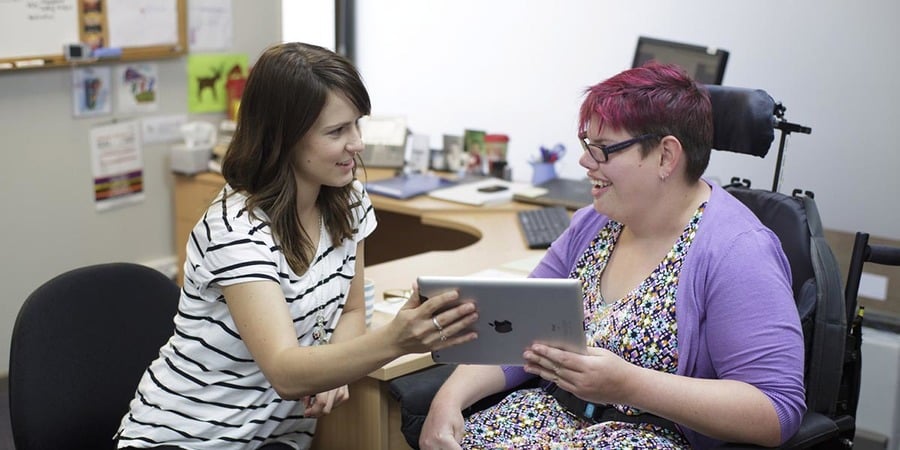
I’m currently working with someone who likes to write. He had trialled different communication options, but the system he had wasn’t being used. We’re now trialling an app that allows him to write on an iPad and converts his words into spoken language.
The important thing is understanding how that person prefers to communicate. People are already communicating in some way. Our role is to recognise it and find what works for them, rather than imposing a particular method.
So, how can we, as communication partners, help create more possibilities to choose?
Start by recognising and validating the person’s own communication.
A facial expression, gesture, vocalisation or subtle change in demeanour can tell us a lot. Someone’s face might light up when they’re interested, or they might communicate that an activity isn’t working for them and they’d rather do something else.
Speech pathologists can help you recognise these communication attempts and understand what the person may be communicating.
Just because someone enjoyed an activity yesterday doesn’t necessarily mean they want to do it again today.
Offer choices rather than assuming you already know what someone wants. Depending on the person, that could mean two options or several.
It can also be helpful to include “something else” as an option. Otherwise, we may unintentionally limit someone’s choice to the things we’ve selected for them.
Communication is a two-way process. Having a way to communicate is only part of the equation – we also need to give individuals the opportunity to use it and respond to what they say.
Sometimes that means slowing down, allowing enough time for someone to respond and resisting the temptation to speak or make a decision for them.
When someone communicates and sees that another person has listened and responded, it reinforces that what they have to say matters.
For me, Possibility to choose is about recognising that everyone has preferences, opinions and things that matter to them – regardless of how they communicate.
Choice doesn’t always mean making a big life decision. It can be choosing a movie, deciding what activity you want to do or simply saying, No, I don’t want that. I want something else.
By creating opportunities for choice and taking the time to listen to the answer, we can help ensure people have a say in the decisions that affect their lives.
Because everyone has something to say. Sometimes we just need to make sure we’re listening in the right way.