Welcome to our 2026 May Research Institute Newsletter.
This newsletter consists of short summaries of completed research led by the CPA Research Institute, our colleagues, international highlights, and information about CPA Research Institute studies which are currently recruiting.
Please see the glossary located at the bottom with definitions for bolded keywords used within summaries. Keywords in summaries will only be bolded the first time they are used.
If you have any suggestions/feedback for this newsletter or questions for the researchers, please contact us here.
On the 23rd of May the 19th annual Grace Gala fundraiser was held, with the extraordinary evening raising funds to support the work of the Grace Centre for Newborn Intensive Care at the Children’s Hospital at Westmead and the Cerebral Palsy Alliance Research Foundation. The night was a momentous success, with over $2 million being raised. This year’s fundraising focus was to fund the training of nurse practitioners, developmental follow-up clinics and the improved capacity to share the amazing work done internationally. Two special panels on the night covering the 1st infusion of cord blood ever delivered compassionately in Australia (2025), and the story of conjoined twins, Tom and Sawong from Papua New Guinea, exemplified the lifechanging progress being made. To find out more or donate please visit here.

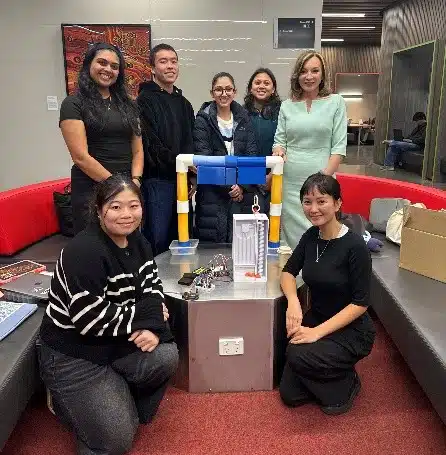
A live panel discussion with The University of Sydney’s BMET5953 Rehabilitation Engineering students showcased the unit’s hands-on, industry-engaged learning approach, bringing students into direct dialogue with leaders across clinical, research, and community settings. Co-hosted by Professor Alistair McEwan and Michael Wong, the session focused on clinical translation in cerebral palsy and community-driven rehabilitation engineering.
The panel featured Professor Nadia Badawi, Chair of Cerebral Palsy at Cerebral Palsy Alliance, and Dr Nicola Postol, Research Fellow, along with Matt Bowtell of Free3D Hands, offering students insight into how rehabilitation technologies move from concept to real-world impact. Through moderated discussion and active Q&A, students explored the technical, ethical, and systems-level challenges of translating assistive technologies, while engaging directly with experts shaping the future of disability innovation.
Authors: Michele Hansen, Anna Kemp-Casey, Sarah McIntyre, Nadia Badawi, Nicole Marie Kiss, Roger J Hart, Elizabeth Milne, Carol Bower, Shona Goldsmith
This study explored whether cerebral palsy (CP) was more common in children conceived via fertility treatments. CP was more common in children conceived via in vitro fertilisation (IVF) than children conceived naturally, but this association has reduced over time. This lines up with a shift to transferring one embryo at a time. CP was also more common in children conceived using ovulation-induction medications alone (mainly Clomiphene). Most differences were explained by babies being born early or as twins and triplets, rather than the treatments themselves. CP was not more common in children whose parents had fertility difficulties but conceived without fertility treatment. Find out more here.

Authors: Natalie Y Lim, Christian E Meagher, Ann Bye, Michelle Lorentzos, Russell C Dale, Shekeeb Mohammad, Katherine B Howell, Elizabeth E Palmer, Ian R Woodcock, Emma Macdonald-Laurs, Anne Preisz, Nadia Badawi, Sandra T Cooper, Stephen C Hille, Toby N Trahair, Anita Cairns, Nicholas Smith, Michelle A Farrar, Didu S Kariyawasam
This study brought together experts, clinicians, and family representatives to develop guidance on how new and advanced treatments—such as gene or cell therapies—should be safely used for children with rare neurological conditions, including some forms of cerebral palsy. The group agreed on practical recommendations covering access to treatment, clear communication with families, choosing which children may benefit, and how to monitor outcomes over time. They highlighted challenges such as high costs, limited access, and uncertainty about long‑term effects. Overall, the study emphasises the importance of fair access, strong communication, and ongoing support to ensure these promising treatments are safe and beneficial. Find out more here.

Authors: Ricardo Rodrigues de Sousa Junior, Luana Cristina da Silva, Ana Cristina Resende Camargos, Eliane Beatriz Cunha Policiano, Lívia Ferreira Coutinho Alonso, Nadia Badawi, Israt Jahan, Gulam Khandaker, Maria De Las Mercedes Ruiz Brunner, Paula Silva de Carvalho Chagas, Hércules Ribeiro Leite
Designed in partnership with two mothers of children with CP, this study looked at school attendance in children and young people with cerebral palsy in Brazil. It used information from the Brazilian Cerebral Palsy Registry (RB-PC) to understand who is attending school and what might affect this. Most children (about three in four) were attending school, but many had difficulty with reading and writing. Older young people with higher mobility and speech support needs were less likely to attend. These results suggest that while access to education has improved, more support is needed—especially for communication and mobility—to help children and young people fully participate and succeed at school. Find out more here.

Authors: Abdul Razak, Suzanne L Miller, Courtney A McDonald, Madison C B Paton, Sophie Sinistaj, Won Soon Park, Augusto Zani, Ishmael M Inocencio, Salvatore Pepe, Bobbi Fleiss, Pierre Gressens, Tim Wolfs, Nancy Messino, Hannah Tribe, Atul Malhotra
This article brings together international research on new cell therapies designed to help babies with serious conditions affecting the brain, lungs, heart, and growth. These treatments use cells from sources such as umbilical cord blood or placental tissues to reduce inflammation, protect brain cells, and support healing. Early studies show these approaches appear safe and may improve outcomes, including for babies at risk of brain injury that can lead to cerebral palsy. However, most treatments are still being tested. Researchers highlight the need for further studies, improved production methods, and strong collaboration to ensure these therapies are safe, effective, and widely available. Find out more here.

Authors: Stephanie Lackey, Shane Pinder, T Claire Davies, Tracy Shepherd, Petra Karlsson, Beata Batorowicz
This study brought together people who use communication aids (AAC), families, and professionals across Canada to agree on what matters most for using these systems in daily life. They found that good communication depends on more than just the device. Important factors included having the right equipment, access to services, support from family and professionals, training, and positive attitudes from others. Being able to communicate was also recognised as a basic human right. For people with cerebral palsy and others with communication difficulties, the findings highlight the need for personalised, well-supported, and coordinated services to help them participate fully at home, school, and in the community.

Research studies and clinical trials are a vital way to identify breakthroughs and advancements in the treatment and prevention of cerebral palsy.
Brazilian Cerebral Palsy Registry (RB-PC) – A Brazilian database collecting information on people with cerebral palsy.
Cell therapies – Treatments using stem or non-stem cells for a range of conditions to help repair or regenerate the body.
Cerebral palsy (CP) – A complex physical condition that affects how a person’s muscles work and how they move throughout their lives. It is caused by early damage to part of the brain, which doesn’t worsen over time but it’s consequences can become more impactful. Each person with CP is unique, and while all having some degree of physical disability, many experience additional learning, communication, visual and/or other challenges. (Dan et al., 2026)
Clomiphene – A medication used to stimulate ovulation.
Communication aids (AAC) – Tools or systems that support people with communication difficulties.
Embryo – A fertilised egg in early development before implantation or growth in the uterus.
Fertility difficulties – Challenges in conceiving naturally.
Fertility treatments – Medical methods that assist with conception.
Gene therapies – Advanced treatments that modify genes to treat a variety of conditions.
In vitro fertilisation (IVF) – A process where fertilisation occurs outside the body.
Neurological conditions – Conditions affecting the brain, spinal cord, or nervous system.
Ovulation-induction medications – Drugs that stimulate egg release from the ovaries.
Placental tissues – Biological material from the placenta used in some medical treatments.
Umbilical cord blood – Blood from the umbilical cord that contains a mixture of cells (stem, immune and others) and is being used to treat various conditions. It is the most researched cell therapy for CP.